How to Play Texas Hold'em

How to Play Texas Hold'em?Rules, Flow, and Decision Logic Explained

From beginner basics to practical understanding, this guide walks you through Texas Hold'em gameplay structure and decision logic.

What Is Texas Hold'em?

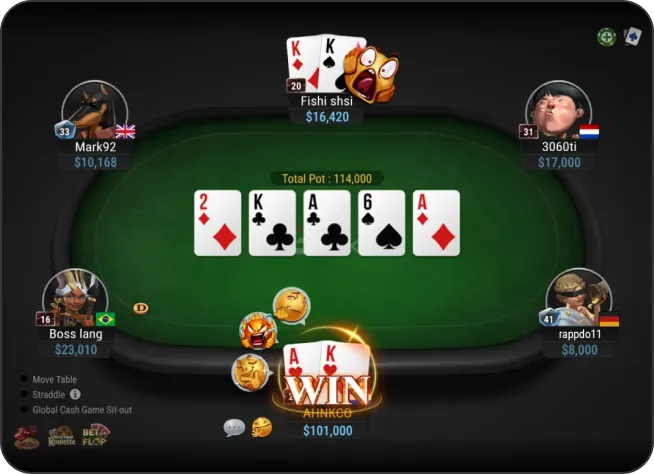
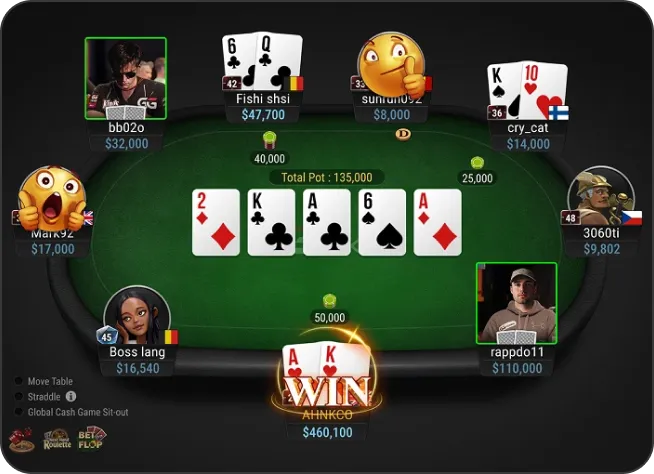
Texas Hold'em is a community-card poker game where the winner is determined by the best five-card hand. It is one of the most mainstream poker formats in the world today. At the start of each hand, every player receives two hole cards and combines them with five community cards dealt in sequence on the table to form the strongest possible five-card hand.

The core of Texas Hold'em is decision-making under incomplete information. Players must continuously make higher expected-value decisions based on board development and opponent behavior.

Therefore, understanding the basic rules and flow of Texas Hold'em is the first step to learning the game.

How To Play
Texas Hold’em

How to Play Texas Hold'em?

A hand of Texas Hold'em is made up of fixed dealing and betting stages. Based on their hole cards and the changing community cards, players decide in each stage whether to continue.

Each hand follows the same dealing and betting order, but not every table will go through every stage in full.

A complete hand typically includes the following steps:

  1. Deal hole cards: each player receives two private cards.
  2. Pre-flop betting: decide whether to continue based on hole cards and position.
  3. Flop: three community cards are dealt.
  4. Turn: the fourth community card is dealt.
  5. River: the fifth community card is dealt.
  6. Showdown or the hand ends by folds.

In any betting round, if all other players fold, the remaining player wins the pot immediately and the hand does not need to reach showdown.

Basic Rules and Betting Actions in Texas Hold’em

In Texas Hold’em, players need to decide whether to put chips into the pot at different stages based on the rules.

Each betting round follows a fixed order of action, and the available action types are clear and limited.

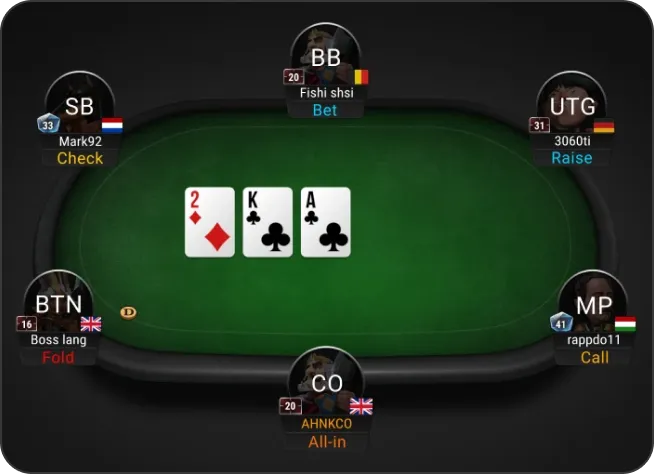
Common betting actions include:

  • Check: continue without putting additional chips in when no bet is required.
  • Call: put in chips equal to the current bet to continue.
  • Raise: increase the amount on top of the current bet.
  • Fold: give up the current hand and exit the pot.
  • All-in: commit all chips currently held in one move.

These actions are not inherently right or wrong by themselves.

Their appropriateness depends on board texture, opponent behavior, and player position.

Basic Rules and Betting Actions

Objective of the Game

The objective of Texas Hold’em Poker is to win the pot by making the best five-card hand possible using any combination of your two hole cards and the five community cards. Played with a standard deck of 52 cards, the goal is to form the highest-ranking hand to outplay your opponents.

In Texas Hold’em Poker, the ranking of hands is as follows:

1. Royal Flush

Ace, King, Queen, Jack, and 10, all of the same suit.

Royal Flush

2. Straight Flush

Five cards in a row, all of the same suit.

Straight Flush

3. Four of a Kind

Four cards of the same rank.

Four of a Kind

4. Full House

Three cards of one rank and two cards of another rank.

Full House

5. Flush

Five cards of the same suit.

Flush

6. Straight

Five cards in a row, but not all of the same suit.

Straight

7. Three of a Kind

Three cards of the same rank.

Three of a Kind

8. Two Pair

Two cards of one rank and two cards of another rank.

Two Pair

9. One Pair

Two cards of the same rank.

One Pair

10. High Card

The highest card in your hand if you don’t have any of the above hands.

High Card

When comparing hands, only the five cards that make up the final hand are evaluated, regardless of whether they come from hole cards or community cards.

If both hand category and highest relevant card values are exactly the same, the hand is treated as a tie.

Common Texas Hold'em Game Types

Based on tournament structure and chip mechanics, Texas Hold'em can be divided into multiple game types.

Different formats show clear differences in pace, risk volatility, and decision patterns.

Common Texas Hold'em game types include:

  • Cash Game

    Players use chips with real monetary value and can join or leave the table at any time. Each hand is relatively independent, and the result of one hand does not affect eligibility to play the next.

  • MTT (Multi-Table Tournament)

    All players enter at the same start time with fixed starting stacks, and eliminated players cannot rejoin. The tournament continues until final placements are determined.

  • SNG (Sit & Go)

    SNG is a small tournament format with a fixed number of entrants, usually starting immediately once all seats are filled. Its structure sits between cash games and large-field tournaments.

Different formats vary in chip flow, elimination mechanics, and overall variance.

Players need to understand these structural differences to correctly identify and evaluate the game format they are in.

Game Terms

Subsequent betting rounds occur after each community card is dealt, continuing clockwise from the player to the left of the dealer.

Hole Cards

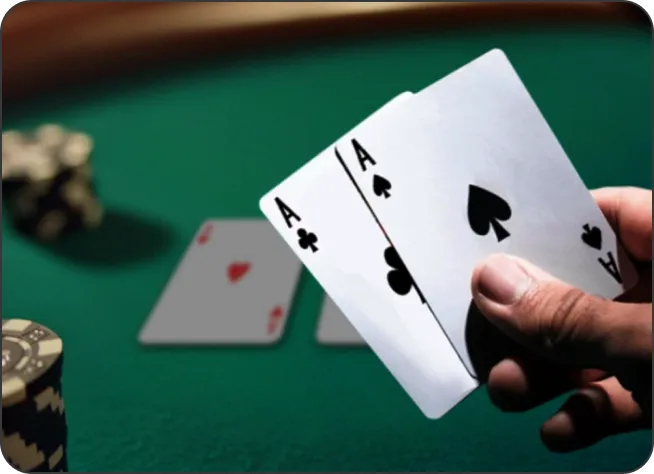
Cards are dealt face-down to each player. When playing Texas Hold 'em, each player receives 2 cards. A player’s hole cards should be kept hidden and never shared between players.

Community Cards

The shared cards each player uses in combination with their Hole Cards to make a 5-card poker hand. The Community Cards are dealt 3 to start, followed by a fourth community card, and then the fifth community card. All community cards are dealt face-up.

Pre-Flop

The round of betting prior to the first 3 Community Cards being dealt.

Burn Card

A card that is discarded prior to each deal of the Community Cards.

The Flop

The first 3 cards dealt as part of the Community Cards. These are followed by the second betting round.

The Turn

The fourth Community Card is dealt, followed by the third betting round.

The River

The fifth Community Card is dealt, followed by the final round of betting.

Blinds

Also known as the Stake or Spread, this refers to the forced bet prior to dealing the cards. In a $1/$2 (spoken as “One Two”) game, the forced bets would be $1 from the Small Blind and $2 from the Big Blind.

The Muck

Facedown pile of dead cards (either folded hands or burn cards)

Chips

Refers to poker chips which are used for betting in place of money.

Core Position Concepts and Decision Context

In Texas Hold'em, player order is referred to as 'position'.

Position determines whether you act before or after your opponents.

In general, players who act later can access more information from opponents.

Because actions such as betting, calling, or folding all transmit information,

even with the same hole cards,

the most reasonable decision can be very different in different positions.

This is one of the key reasons Texas Hold'em is considered a skill- and judgment-based game.

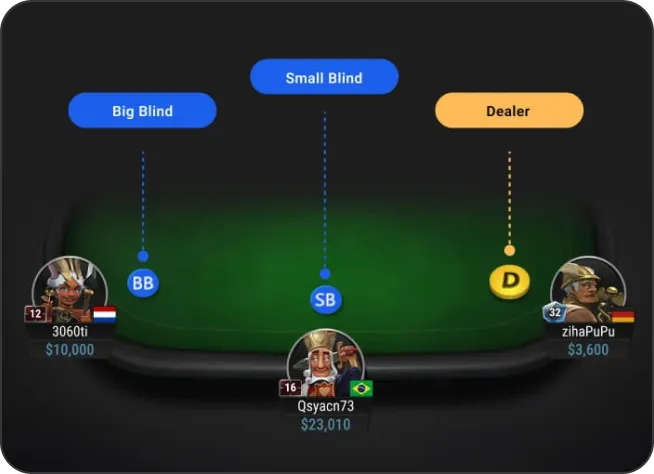
Dealer

One player is designated as the dealer for each hand of poker. Normally indicated by a large Dealer button, the dealer is the last player to receive cards and to act during each round of betting. After each hand, the puck passes to the next seat clockwise around the table. The Big Blind is two seats clockwise from the Dealer.

Small Blind (SB)

The player or seat immediately between the dealer and the Big Blind. Prior to the deal, the Small Blind will put in a forced bet equal to half the minimum bet. It is possible that the Small Blind position is unoccupied. If that happens, there will not be a Small Blind for the hand.

Big Blind (BB)

The player immediately to the left of the Small Blind. Prior to the deal, the Big Blind will put in a forced bet equal to the minimum bet amount.

Under the Gun (UTG)

The player immediately to the left of the Big Blind. This player starts the action in the first round of betting.

Cut Off (CO)

The player seated to the immediate right of the Dealer.

Early Position

One of the first third of players to make an action in a poker hand. Playing 6-handed, the first 2 players, the Small Blind and Big Blind, would be considered to be in Early Position.

Late Position

The last third of players who will make an action in a hand of poker. Playing 6-handed, the last 2 players would be considered to be in Late Position.

Middle Position

The players that do not fit the definition of either Early or Late position. These players are to the left of the Big Blind.

Position at the Table
Actions at the Table

Risk Awareness and Rational Participation in Texas Hold’em

Texas Hold'em includes multiple betting rounds, where players can choose to bet, raise, or fold.

Although Texas Hold'em involves strategy and judgment, randomness and variance risk still exist.

In the short term, dealing outcomes can have a significant impact on single-hand results,

and even sound decisions may still lead to consecutive unfavorable outcomes.

Over the long run, decision quality and risk management matter more,

but any participation should be based on rational understanding and self-control.

Participants are advised to understand both rules and risks first,

set affordable bankroll limits, avoid emotional decisions,

and treat learning and rational participation as the primary goals.

Check

Passing the action to the next player. This action can only be taken if no other action has been taken during the current round of betting. The Small Blind cannot take this action during the first round of betting (also referred to as the pre-flop action).

Bet

Putting chips or money into the pot.

Fold

After a Bet is made, a player can Fold their hand by gently tossing the cards face down into the center of the table. Once a hand is folded, the player is out of the hand and cannot take any other action until the next hand.

Call

After a Bet is made, a player can match the Bet and continue playing the hand. In the case where a player does not have enough to cover the bet, the player is ‘All In’. Any part of the bet the “All In” player cannot match is put into a separate pot (Side Pot) that the “All In” player is not eligible to win.

Raise

After a Bet is made, a player may choose to Raise the bet. A Raise needs to be greater than the current bet by an amount equal or greater than the last bet made. A raise can only be less than the previous bet in the case of an All-In.


Texas Hold’em Frequently Asked Questions (FAQ)

  1. Is Texas Hold’em more about luck or skill?

    Texas Hold’em includes random dealing, so short-term results can be strongly affected by luck. Over large long-term samples, however, decision quality, rule understanding, and risk management have greater impact on outcomes.

  2. Is Texas Hold’em considered gambling?

    Texas Hold’em includes uncertainty, but player choices, information judgment, and long-term strategy significantly affect results, so it is often viewed as a poker game that combines probability and skill components.

  3. Is Texas Hold’em suitable for beginners?

    Yes. With a clear understanding of basic rules and risks, beginners can start from simpler formats and gradually build familiarity with game flow and decision logic.

  4. Why do strong starting hands still lose sometimes?

    Single-hand outcomes are influenced by community-card runouts and opponent actions. Good decisions do not guarantee every hand will win; evaluation should focus more on long-term results.

  5. Does every hand have to go all the way to the river?

    No. In any betting round, if all other players fold, the hand ends immediately and no showdown is needed.

  6. How is a winner determined when hand categories are the same?

    When hand categories match, the highest relevant card values that form the final hand are compared. If all compared values are identical, the hand is a tie.

  7. Why is position so important in Texas Hold’em?

    Action order changes how much information a player can observe. Even with the same hole cards, different positions can require different decisions.

  8. Is there risk in Texas Hold’em?

    Yes. Texas Hold’em has variance and uncertainty. Any participation should be based on rational understanding, self-control, and an affordable risk range.

  9. How is Texas Hold’em different from other poker games?

    Texas Hold’em uses a community-card system where players combine private hole cards with board cards. Compared with formats that rely only on private cards, it places more emphasis on information analysis and decision process.

  10. How many players can usually sit at one Texas Hold’em table?

    Common table sizes range from 2 to 9 players. The exact number depends on table configuration and game format, and it affects action order and game pace.

  11. Does every hand require a bet?

    No. In some betting rounds, if no one has bet, a player can check and continue without putting chips in.

  12. What fundamentals should I learn first?

    Start with core rules, betting flow, hand rankings, and position concepts. These are the foundation for sound judgment before moving into more advanced strategy and analysis.

如果你已经理解了德州扑克的基本规则,可以通过实际对局来加深对流程、节奏与决策变化的理解

以下链接仅用于参考实际对局形式,不构成任何参与或推荐行为

本站不提供任何实时对局或参与功能。