

Whether you are playing online poker or live in a poker room, you will almost always be able to find a game of Texas Hold’em poker. From the first iteration of modern poker, estimated to have been played in the early 1800’s on the Steamboats of the Mississippi and in the saloons of the Old West, to the modern face of online poker, the game of poker is known worldwide and Texas Hold’em stands atop the mountain of variations. Seconds to learn, a lifetime to master, the unlimited excitement will keep you learning hand after hand.
You’ve seen it played on TV, watched highlight clips on various social media platforms, talked about it with your friends and now you want to learn how to play Texas Hold’em poker.
To succeed at Texas Hold'em or any other poker games, you need to understand the rules. Regardless if you are a complete beginner trying to understand the basic rules of how to play, or a veteran looking for a quick refresher course, DXPoker is here to help. As you begin your journey or continue down your path, here are rules for the poker game of Texas Hold’em. Armed with this knowledge you are on your way to develop your own strategy and style of play.
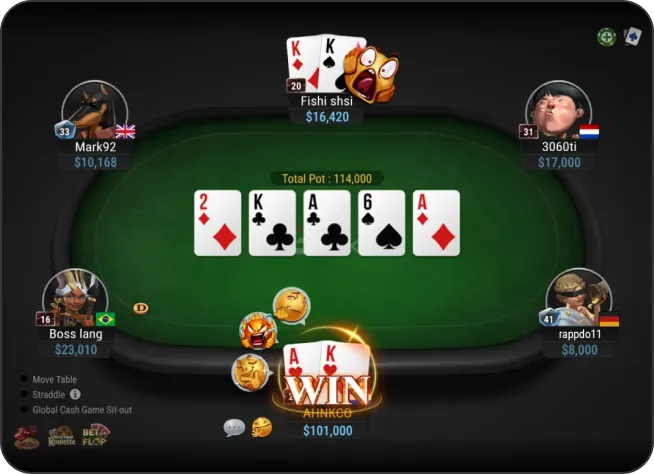
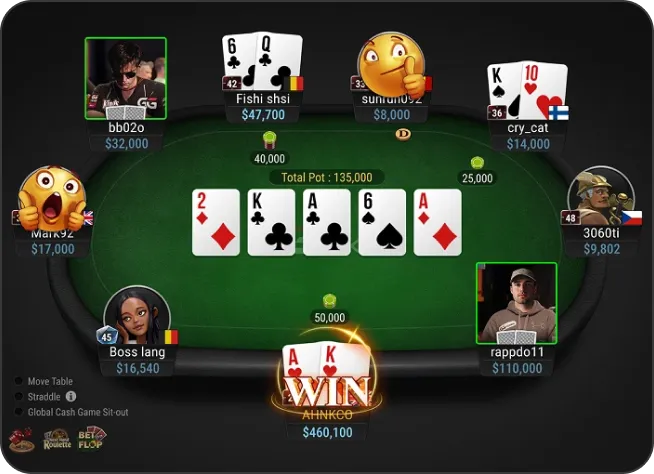
No matter how you say it: Texas Hold’em, Texas Holdem, or Texas Hold em, of all of the poker games, Texas Hold’em is the most popular poker variant in the world. It is so popular that the World Series of Poker has a widely televised main event every year mixed in a robust broadcast schedule.
Played with a standard 52 card deck, it is usually played with 9-10 players at a table (at DXPoker the max number of players we have is 9) but can readily be found with fewer players.
A hand starts with each player being dealt 2 cards facedown, known as hole cards. This is followed by 5 face-up ‘Community Cards’ dealt in a 3-1-1 pattern, known as ‘the flop’, ‘the turn’, and ‘the river’. The first betting round happens before the flop. The flop is followed by a second betting round. Then comes the turn, followed by the third betting round, and finally the river and the last betting round. The river, which is followed by the fourth betting round, leads to the showdown if necessary to determine the winning hand. There are a total of 4 betting rounds, 1 betting round after each deal, regardless if the cards are dealt face up or dealt face down. After the final betting round, the hole cards are turned over and the player with the best 5-card poker hand wins. In cases where a player's made hand has fewer than five cards, such as two pair or three of a kind, the highest available dealt cards are used to complete the 5 card hand. These cards are known as ‘kickers’ and are used to break ties.
Texas Hold’em Poker has a rich and fascinating history that spans over a century. The game originated in the early 20th century in the state of Texas, USA, and was initially played by a small group of enthusiasts. It wasn’t until the 1960s and 1970s that Texas Hold’em began to gain widespread popularity, particularly in the vibrant city of Las Vegas. A group of Texan gamblers and card players introduced the game to the casinos, and it quickly caught on.
One of the most significant milestones in the history of Texas Hold’em Poker was Benny and Jack Binion's establishment of the World Series of Poker (WSOP) in 1970. Initially, a small tournament attracting a handful of players, the WSOP rapidly grew in popularity and prestige, becoming one of the most renowned poker tournaments globally.
The 1980s and 1990s saw a surge in the game’s popularity, fueled by the rise of online poker and the introduction of other Poker Tours. These developments brought Texas Hold’em to a broader audience, making it accessible to millions of players worldwide. The WSOP became a household name, drawing in players from around the globe.
Today, Texas Hold’em Poker is one of the most popular poker games in the world. Millions of players engage in cash games, limit games, and tournaments daily, both online and in live settings. The game has also inspired various exciting variations, including No Limit Hold’em, Pot Limit Hold’em, and Mixed Hold’em, each offering unique rules and strategies.

The objective of Texas Hold’em Poker is to win the pot by making the best five-card hand possible using any combination of your two hole cards and the five community cards. Played with a standard deck of 52 cards, the goal is to form the highest-ranking hand to outplay your opponents.
In Texas Hold’em Poker, the ranking of hands is as follows:
1. Royal Flush
Ace, King, Queen, Jack, and 10, all of the same suit.

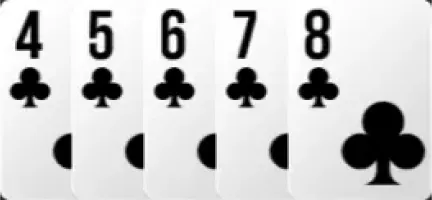
2. Straight Flush
Five cards in a row, all of the same suit.
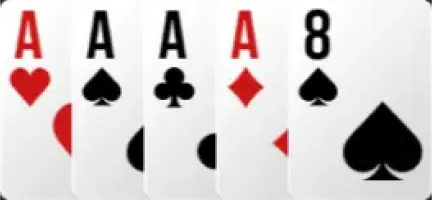
3. Four of a Kind
Four cards of the same rank.
4. Full House
Three cards of one rank and two cards of another rank.
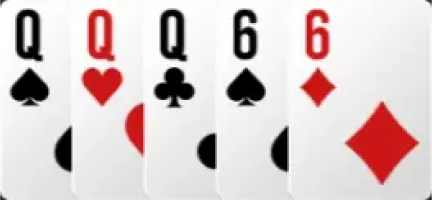
5. Flush
Five cards of the same suit.
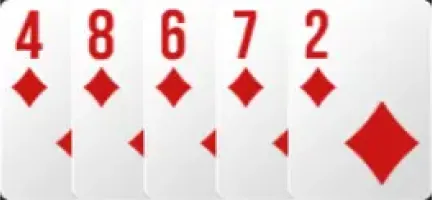
6. Straight
Five cards in a row, but not all of the same suit.
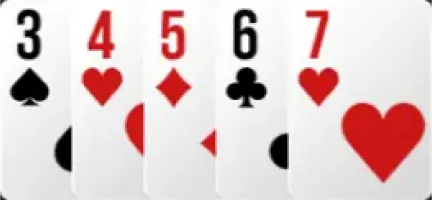
7. Three of a Kind
Three cards of the same rank.
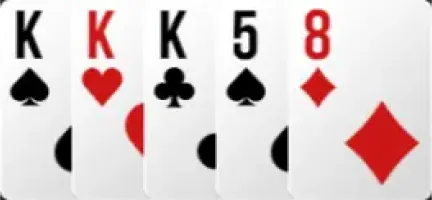
8. Two Pair
Two cards of one rank and two cards of another rank.
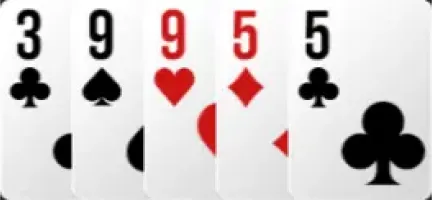
9. One Pair
Two cards of the same rank.
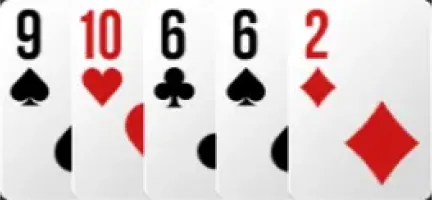
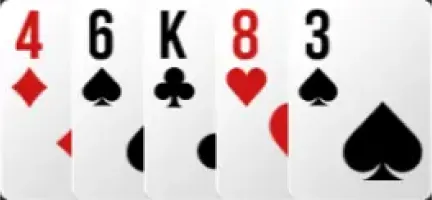
10. High Card
The highest card in your hand if you don’t have any of the above hands.
Understanding these hand rankings is crucial for making strategic decisions during the game and ultimately winning the pot.
One of the most important concepts when you play poker is the betting structure. For the purpose of betting, poker games are broken into 3 types: Limit Games, Pot Limit Games, or No Limit Games (all Texas Hold’em at DXPoker is No Limit). At many online poker sites like DXPoker, you can find these betting structures in tournaments and in cash games. In most poker games, including Texas Hold'em, understanding the betting structure is crucial for strategic play.
betting presets how much each bet and raise must be, as well as how many total bets and raises can be made each betting round.
betting does not cap the number of bets that can be made during each round of betting but limits the maximum bet during each betting round by how much is currently in the pot. The maximum bet includes any bets from the current round plus the amount of the bet you are facing (e.g., if the pot is $10 and there is a $1 bet that you would need to call, the maximum you could raise is $12 - $10 that is in the pot, the $1 bet you are facing plus the $1 you need to call).
betting has no limit or cap on any aspect of the betting. It is in this betting format that you will regularly hear a player say “All In".
No different than other games, there is terminology used at the poker table that is either unique to the game or has an alternate meaning when playing poker. You want to learn how to play poker, that’s why you found this page. Here are some of the most important ones to know when playing poker:
Subsequent betting rounds occur after each community card is dealt, continuing clockwise from the player to the left of the dealer.
Cards are dealt face-down to each player. When playing Texas Hold 'em, each player receives 2 cards. A player’s hole cards should be kept hidden and never shared between players.
The shared cards each player uses in combination with their Hole Cards to make a 5-card poker hand. The Community Cards are dealt 3 to start, followed by a fourth community card, and then the fifth community card. All community cards are dealt face-up.
The round of betting prior to the first 3 Community Cards being dealt.
A card that is discarded prior to each deal of the Community Cards.
The first 3 cards dealt as part of the Community Cards. These are followed by the second betting round.
The fourth Community Card is dealt, followed by the third betting round.
The fifth Community Card is dealt, followed by the final round of betting.
Also known as the Stake or Spread, this refers to the forced bet prior to dealing the cards. In a $1/$2 (spoken as “One Two”) game, the forced bets would be $1 from the Small Blind and $2 from the Big Blind.
Facedown pile of dead cards (either folded hands or burn cards)
Refers to poker chips which are used for betting in place of money.
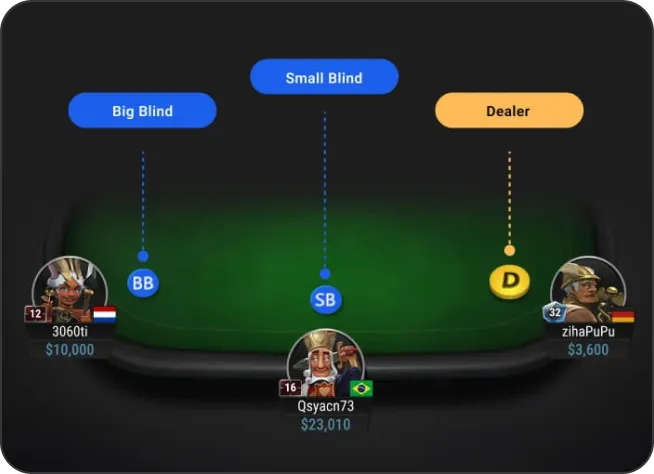
One player is designated as the dealer for each hand of poker. Normally indicated by a large Dealer button, the dealer is the last player to receive cards and to act during each round of betting. After each hand, the puck passes to the next seat clockwise around the table. The Big Blind is two seats clockwise from the Dealer.
The player or seat immediately between the dealer and the Big Blind. Prior to the deal, the Small Blind will put in a forced bet equal to half the minimum bet. It is possible that the Small Blind position is unoccupied. If that happens, there will not be a Small Blind for the hand.
The player immediately to the left of the Small Blind. Prior to the deal, the Big Blind will put in a forced bet equal to the minimum bet amount.
The player immediately to the left of the Big Blind. This player starts the action in the first round of betting.
The player seated to the immediate right of the Dealer.
One of the first third of players to make an action in a poker hand. Playing 6-handed, the first 2 players, the Small Blind and Big Blind, would be considered to be in Early Position.
The last third of players who will make an action in a hand of poker. Playing 6-handed, the last 2 players would be considered to be in Late Position.
The players that do not fit the definition of either Early or Late position. These players are to the left of the Big Blind.
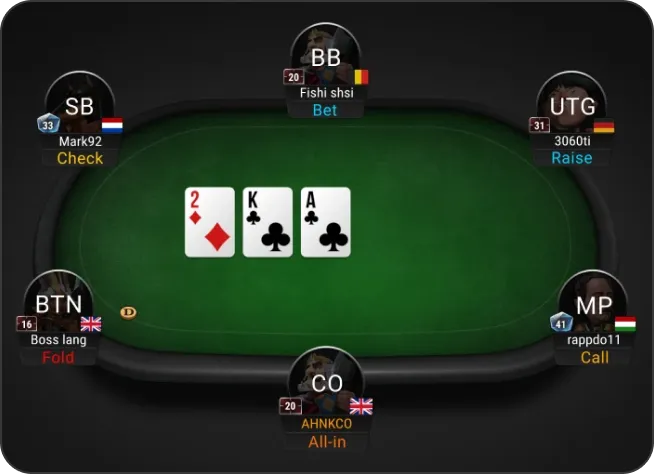
Texas Hold'em involves multiple rounds of betting, each providing players with opportunities to bet, raise, or fold.
Passing the action to the next player. This action can only be taken if no other action has been taken during the current round of betting. The Small Blind cannot take this action during the first round of betting (also referred to as the pre-flop action).
Putting chips or money into the pot.
After a Bet is made, a player can Fold their hand by gently tossing the cards face down into the center of the table. Once a hand is folded, the player is out of the hand and cannot take any other action until the next hand.
After a Bet is made, a player can match the Bet and continue playing the hand. In the case where a player does not have enough to cover the bet, the player is ‘All In’. Any part of the bet the “All In” player cannot match is put into a separate pot (Side Pot) that the “All In” player is not eligible to win.
After a Bet is made, a player may choose to Raise the bet. A Raise needs to be greater than the current bet by an amount equal or greater than the last bet made. A raise can only be less than the previous bet in the case of an All-In.